
News

District 2 Legislative team to address e-bike safety

July 29, 2025

Breaking AC

By Nanette LoBiondo Galloway

Following the death of a young e-bike rider in Somers Point last week, members of New Jersey’s District 2 Legislative team are seeking ways to strengthen safety requirements for e-bike operators.

“After some initial research, it was clear that New Jersey does not offer proper safety instruction for these young riders,” state Sen. Vince Polistina said. “In working with the Office of Legislative Services, we are drafting a bill to create an operator’s safety course for Class I and Class II e-bike operators.”

A 14-year-old boy from Egg Harbor Township died July 18, a day after he collided with a vehicle while riding his motorized bike in Somers Point.

Following the that accident, the District 2 Legislative Office received multiple inquiries from residents and local officials seeking explanation on the current e-bike laws and what legislative fixes could be introduced. 

He joined Assemblyman Don Guardian and Assemblywoman Claire Swift on Tuesday, in called to strengthen safety requirements for e-bike operators. 

“There are no other motorized vehicles that you can legally operate on land or on our waterways that do not require some type of certification or licensing,” said Swift, a former NJ deputy attorney general. “We do this to ensure responsible operation and keep everyone safe on the roads. We need to provide the same for our e-bikers.”

Guardian added that e-bikes are far more dangerous than a manually pedaled bike and should be regulated more like scooters and mopeds. 

“These e-bikes have the ability to carry a rider up to 20 miles an hour, nearly twice the average speed of a traditional bike,” Guardian said. “As the speed increases, so does the need for knowledge about how to safely operate an e-bike.”

The fatal crash also prompted Atlantic County Prosecutor William Reynolds to pen an editorial asking parents to reconsider purchasing e-bikes for their children, who may not have the situational awareness to make split-second decisions in a high-risk environment.

“The growing popularity of e-bikes, electric scooters and golf carts on our roads — often operated by teenagers — presents new and significant dangers,” Reynolds wrote. “These vehicles can reach high speeds, often without the safeguards and regulations required for cars or motorcycles. And while they may appear fun and convenient, we cannot allow their novelty to blind us to the reality: they are fast, heavy, motorized machines being operated in live traffic, often by kids who are not developmentally ready for that responsibility.”

On Sunday, a 17-year-old teen was injured in a crash with a vehicle near the Walmart in Mays Landing. The teenager was not wearing a helmet and sustained non-life threatening injuries.

Reynolds said the state needs better policies regarding e-bikes.

“Manufacturers and retailers must do their part to educate consumers — not just sell a product,” he said.

The Ventnor City Board of Commissioners has fielded numerous complaints from city residents, mostly senior citizens, about e-bike riders whizzing by them as they try to walk on the boardwalk.

Although the commissioners have said they would review city ordinances to see if changes can be made, such as establishing a speed limit, there are several classes of e-bikes on the market, some that even seniors like to use because they are easier to ride. 

The boardwalk is designed as a pedestrian pathway. 

“The concern we have is the weight of the vehicle and the potential speed…in a shared space…” Mayor Tim Kriebel said.

The city has hired extra Class I officers this year to patrol the boardwalk to change the behavior of e-bike and even traditional 10-speed bike riders who are speeding, he said.

Polistina said the legislation would likely require any operator of any class of e-bike to take a mandatory safety class and obtain certification, similar to the state’s Boating Safety Certificate program.

“If law enforcement stops them while riding an e-bike and they can’t produce the certificate, they will be subject to a fine,” he said.

Polistina said the legislative team will be drafting legislation in the next two weeks for introduction once the legislature reconvenes after the November election.

Polistina, Guardian & Swift Call for Strengthening E-Bike Safety Standards

July 29, 2025

New Jersey Senate Republicans

Following a local tragedy which resulted in the death of an Egg Harbor Township teen earlier this month, Senator Vince Polistina, Assemblyman Don Guardian and Assemblywoman Claire Swift (R-Atlantic), today called for strengthening safety requirements for e-bike operators.

“First and foremost, our condolences are with the Sullivan family in the wake of this unspeakable tragedy,” Senator Polistina said. “As we see an increased use of these types of electric bicycles, so too do we see an increase in accidents.”

Polistina explained that following the July 17th accident, the Legislative Office he shares with Assemblyman Guardian and Assemblywoman Swift received multiple inquiries from residents and local officials seeking explanation on the current e-bike laws and what legislative fixes could be introduced.

“After some initial research, it was clear that New Jersey does not offer proper safety instruction for these young riders,” Polistina added. “In working with the Office of Legislative Services, we are drafting a bill to create an operator’s safety course for Class I and Class II e-bike operators.”

Assemblyman Don Guardian added that e-bikes are far more dangerous than a manually pedaled bike and should be regulated more like scooters and mopeds. “These e-bikes have the ability to carry a rider up to twenty miles an hour, nearly twice the average speed of a traditional bike,” explained Guardian. “As the speed increases, so does the need for knowledge about how to safely operate an e-bike.”

“There are no other motorized vehicles that you can legally operate on land or on our waterways that do not require some type of certification or licensing,” explained former NJ Deputy Attorney General, Assemblywoman Claire Swift. “We do this to ensure responsible operation and keep everyone safe on the roads. We need to provide the same for our e-bikers.”

The legislative team is expecting the draft to be completed sometime in the next two weeks and plans to introduce it once the legislature reconvenes after the summer recess.

Republican Lawmakers Support Bill That Defines Antisemitism

July 25, 2025

NJ Assembly GOP

TRENTON, N.J. – New Jersey is one step closer to officially defining antisemitism.

After a contentious, hours-long meeting, the Assembly State and Local Government Committee on Thursday released the bill (A3558) that establishes a uniform definition of antisemitism based on the May 26, 2016 definition adopted by the International Holocaust Remembrance Alliance.

“As a lifelong resident of Margate and Atlantic County, we have a vibrant Jewish community, who are a tremendous asset to our community and state. I along with my family and children are lifelong members of the Margate JCC, an active member of our local Jewish Federation and Jewish Family Services, which provides invaluable resources and helps thousands of our constituents,” Assemblywoman Claire Swift (R-Atlantic), a member of the State and Local Government Committee, said. “The fact that we have to vote on a bill to define antisemitism is antiquated and inconceivable.”

The bill comes in the aftermath of the Oct. 7, 2023, Hamas terrorist attack in Israel, in which 1,200 Israelis and 46 American citizens were killed and 251 people taken hostage. Since that attack, the Anti-Defamation League has reported a record-breaking number of antisemitic incidents, with a 5% increase from the previous year and a 344% increase over the past five years. New Jersey ranked third, after New York and California, for the highest number of reported antisemitic incidents among states.

The bill’s primary sponsors—Michael Inganamort (R-Morris) among them—stressed that the bill does not infringe on protected First Amendments rights or academic freedom.

“As an ordained deacon in a Historical Black Church for over two decades, I believe that hate speech is not free speech no matter the religion, race, ethnicity, et cetera,” Assemblyman Erik Simonsen (R-Cape May), also a member of the committee, said. “This is unacceptable anytime and anywhere.”

Swift and Simonsen, along with 19 other members of the Assembly Republican Conference, cosponsored the bill.

Service Industry Upheaval: Atlantic and Cape May Lawmakers Speak Out Against Bill Targeting Tipped-Wage Workers

April 10, 2025

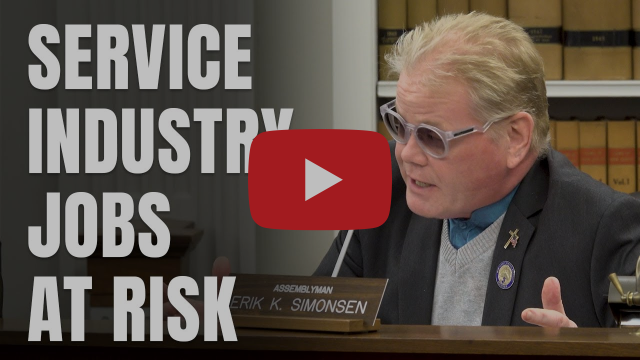
A bill throwing New Jersey’s service industry into upheaval that was up for discussion in the Assembly State and Local Government Committee on Thursday drew sharp criticism from business owners, tipped workers, and Republican committee members Assemblywoman Claire Swift and Assemblyman Erik Simonsen. 

“When I saw this bill, I said, ‘How much more can they destroy the restaurant businesses?’ Our congressional district has the most establishments and the most employees in all of New Jersey,” Swift (R-Atlantic) said following a round of applause to her vocal opposition of the measure (A5433).

WATCH: Swift Defends South Jersey Restaurants & Workers

Currently, a tipped worker’s gratuities for the day and the $5.62 an hour from the business must equal the state’s minimum wage of $15.49, otherwise the employer needs to pay more an hour to make up the difference. The Democrat-sponsored bill under debate would require the employer to pay tipped workers a base minimum wage of $15.49 an hour regardless of much they make in tips.

“As someone who grew up in the industry and worked through high school and paid my way through college, I’ve seen how careers are made,” Simonsen (R-Cape May) said.

WATCH: Simonsen: “We’re Not California — Let’s Keep New Jersey Working”

Those who showed up to testify against the bill in Trenton stressed how the bill would increase labor costs for employers and lower opportunities for service workers. One restaurant owner said after significant layoffs, he would eventually need to close and look into other development opportunities. Tipped workers argued they make more than their salaried counterparts and never asked for this legislation.

“I can’t wrap my head around this bill. But, there’s some real simple math for you and that’s the fact that there’s seven states that do it, which means there’s 43 states that don’t. That tells me what I need to know. We’re New Jersey and let’s keep it that way,” Simonsen added.

Testimony highlighted how the measure would disproportionately impact areas of the state that rely heavily on the hospitality and tourism industries, including Atlantic City and other shore points; however, the economic consequences would be felt throughout New Jersey.

“The timing of this bill is horrible. The price of gas is up. The price of food is up. Payroll taxes have increased. Our tourism season begins next week. We’re going to do everything we can to oppose this bill,” Swift said.

Here’s the final list of who’s running for N.J. governor and Assembly this year

April 3, 2025

New Jersey Globe

By Zach Blackburn and Joey Fox

Conventions are over, petitions are filed, and candidate lists are out: it’s time for primary season in New Jersey to officially begin.

The filing deadline to run in the primary for governor, State Assembly, or any other partisan office up this year was on March 24 at 4 p.m., and 11 gubernatorial candidates and more than 200 Assembly candidates (plus two candidates for a special State Senate election) heeded the call. Both parties are contesting nearly every legislative district in the state, though Democrats make up nearly three-fifths of all candidates who filed.

A handful of other candidates initially filed to run as well, but were barred from the ballot due to issues with their signatures. Legislation signed into law this year increased the number of signatures required for Assembly to 250 (up from 100) and for governor to 2,500 (up from 1,000); some candidates struggled to meet the new requirements, and at least six Assembly candidates were rendered ineligible after challenges to their petitions (as well as a seventh who had residency issues).

Many districts are set to host extremely competitive primaries, and the fight for the governorship is hotly contested on both sides of the aisle as well. And with new legislation in place abolishing the county organizational line and implementing office-block ballots, some county political parties are facing the toughest test of their might in decades.

LD-2 (Atlantic)

Atlantic County Democrats and Team Fulop are duking it out in the Atlantic City-based 2nd district; retired attorney Maureen Rowan and Pleasantville Councilwoman Joanne Famularo, who lost a close race for county commissioner last year, are running on the organization ticket, while former Atlantic City Councilman Bruce Weekes and Linwood Board of Education member Lisa Bonanno are on the Democrats for Change slate.

The winners will go up against Republican Assemblymembers Don Guardian (R-Atlantic City) and Claire Swift (R-Margate), who have no primary opponents. The 2nd district could be competitive – Kamala Harris narrowly carried it last year even as she lost Atlantic County – but Guardian and Swift are seen as strong incumbents who will be tough to beat.

New Jersey eyes decriminalizing underage gambling and using fines for compulsive betting treatment

March 6, 2025

Press of Atlantic City

By Wayne Parry

TRENTON — Sam Antar was 18 the first time he gambled with friends in an Atlantic City casino — even though the legal gambling age was 21.

No one stopped him.

“Nobody bothered us,” he said. “They just wanted our money.

Antar would go on to develop a severe gambling problem that led to him committing crimes to feed that addiction, landing him in jail multiple times.

Rob Sackowitz started gambling at age 13; by 16, he was attending Gamblers Anonymous meetings.

“From 18 to 35, I went through hell,” he said. “I was arrested nine times, had two DWIs, I was getting kicked out of a family business and had a wife that was leaving.”

In retrospect, both men say, their lives might have taken a much different turn had they been caught at an early age and forced to undergo court-ordered treatment.

“I could have maybe avoided all of it,” Antar said. “Maybe if I got in trouble, I could have said to myself, ‘Hey, I need to do the right thing here and not throw my life away when my life was just getting started.’”

“Pain becomes a great motivator,” Sackowitz added. “As a teenager, you almost feel like you’re invincible.”

New Jersey is rethinking how it deals with underage gambling, moving toward making such activity a civil offense rather than a crime, with fines going to fund programs for compulsive gamblers.

A package of bills moving through the state Legislature aims to change the emphasis from punishment to rehabilitation, while providing additional money for badly needed treatment programs.

“Sixty to 80% of high school students report having gambled for money within the past year,” said Assemblywoman Claire Swift, R-Atlantic, a sponsor of one of the bills.

The New Jersey Attorney General’s Office said at least 39 people ages 18 to 20 were charged with underage gambling between 2017 and 2021. The statistics do not include those younger than 18.

One of the bills would decriminalize gambling by someone under the age of 21; current law classifies the crime as a disorderly persons offense.

It would instead impose a civil fine of up to $500 for the first offense, $1,000 for the second offense and up to $2,000 for subsequent offenses. The fines would be used for prevention, education and treatment programs for compulsive gambling, such as those provided by the Council on Compulsive Gambling of New Jersey.

A second bill would require someone convicted of underage gambling to participate in a compulsive gambling prevention, education and treatment program.

Lack of regulation means no gambler exclusion lists, no anti-addiction programs and no rules that govern acceptable payouts.

A judge would have the option to suspend a fine in these cases.

And a third would require each high school district in the state to incorporate instruction on the potential risks of compulsive gambling into its health and physical education curriculum.

Arnie Wexler, the former head of New Jersey’s compulsive gambling council, now works with people who have gambling problems. He said the percentage of teens seeking help — or their parents seeking it for them — is constantly increasing.

“These kids are 15, 16, 17, and they’re in so deep,” Wexler said.

Through his program, Right Choice Recovery, Sackowitz counseled one 17-year-old from New Jersey who used his mother’s Social Security number to open a PayPal account that he used to fund online gambling, where he quickly lost $100,000.

“He was making 3,000 to 4,000 bets a day: roulette, blackjack, betting ball games,” Sackowitz said. “That’s an incredible amount of action for one person in one day.”

Luis Del Orbe, acting executive director of the state’s compulsive gambling council, said the organization conditionally supports the decriminalization bill.

“Gambling has been normalized in our society, and the youth are bound to experiment,” he said. “Apart from a fine, which most likely the parents would be paying, we do want to see that youth who engage in underage gambling also receive education about problem gambling harms.”

Antar is the nephew of Eddie Antar, who founded the Crazy Eddie chain of electronics stores in the 1970s and 1980s, known for their television ads screaming about prices that were “insaaaane!” Eddie Antar defrauded investors out of more than $74 million, and died in 2016.

In 2013, Sam Antar was sentenced to 21 months in federal prison for taking $225,000 in a fraudulent investment scheme. He was convicted and jailed in 2022 on theft by deception charges involving nearly $350,000.

In 2023, he admitted committing federal securities fraud for bilking investors, including friends stemming from that same case, served four months in jail and was ordered to pay restitution.

He tried suing Borgata Hotel Casino & Spa in 2022, alleging the casino and its parent company knew he had a gambling addiction but allowed him to bet anyway.

In the lawsuit, Antar, who had homes in New York and Long Branch, said he gambled $30 million over 100,000 in-person and online bets during nine months in 2019. He said he is not certain exactly how much he lost in total, but his lawyer says it was “at least in the six figures.”

A judge dismissed that suit, ruling that the casinos have no obligation to stop compulsive gamblers from betting. Antar is trying to have the case reinstated on appeal.

He now lives in Florida and says he works to counsel young people with gambling problems.

He strongly supports teaching students about the dangers of gambling as part of their school curriculum.

It took Sackowitz seven years to pay off the $750,000 he owed to bookies, loan sharks, friends and acquaintances.

He called the bills being considered “an excellent idea for minors.”

“Your life is not over because you can’t bet anymore,” he said.

Conference Highlights Power of State Public Higher Education

February 27, 2025

Stockton University

By Mark Melhorn and Stacey Clapp

Galloway, N.J. — How important are public colleges and universities in New Jersey?

They generate $6 billion in economic activity and contribute $220 million in tax revenue to the state each year.

For every $1 million invested in the seven public institutions of higher education, including Stockton University, $16 million in economic activity is generated, supporting about 36,000 jobs in the Garden State, according to the New Jersey Association of State Colleges and Universities (NJASCU).

“These institutions not only shape the future of our workforce, but also act as a stabilizing influence, ensuring access to an affordable, high-quality education in the face of shifting national priorities,” said NJASCU Executive Director Jennifer Keyes-Maloney. “Now more than ever, they deserve the attention, resources and support to continue their essential mission.”

Keyes-Maloney was the keynote speaker at a conference titled “The Power of Public Colleges and Universities: Preserving and Advancing New Jersey’s Higher Education Landscape.” The event was held Feb. 26 at Stockton and attended by about 90 state legislators and community and higher education leaders. Among the legislators who participated in the panel discussions were State Senator Vince Polistina, Assemblywoman Claire Swift and Assemblyman Don Guardian.

Stockton President Joe Bertolino initiated the conference because he felt it was important to bring state stakeholders together to discuss the best ways to strengthen and revitalize New Jersey’s public higher education system into the future.

“Ultimately, we share a common mission and that is to ensure that our public colleges and universities remain strong, they remain accessible and prepared to meet the evolving needs of our students, our workforce and our communities,” he said.

Bertolino believes that higher education and the perception of its value is at a crossroads.

“We are grappling with declining enrollment, shifting workforce demands, a changing financial landscape and most significantly the influence from an impact of federal regulations and changes to both policies and funding have presented significant challenges to our institutions,” he said.

“However, amidst all these challenges, one fact remains: Our New Jersey public colleges and universities are engines for economic growth. We prepare thousands of students each year. Students who go on to fuel our workforce, lead our businesses and serve in our communities.”

The event consisted of four panel discussions on how higher education can be an economic engine, how colleges and universities serve different populations and drive social mobility, how alums from New Jersey schools have benefitted from a public education, and how legislation can strengthen these institutions.

In the first panel, Vincent D’Alessandro, director of Government Banking at OceanFirst Bank, talked about how his company prioritizes involvement with higher education institutions to mentor and support students. Since 2017, the bank’s foundation has awarded $320,000 in scholarships to Stockton students, but there are challenges.

“Trying to find talent is an absolute battle. I’m here today to talk about solutions to keep these kids in New Jersey and to keep them engaged,” he said.

Oliver Cooke, professor of Economics at Stockton, added that higher education institutions are community anchors that are critical to the future of their regional economy.

“Continuing to invest significant dollars (in colleges and universities) is something we have to do. The most recent data shows individuals with a bachelor’s degree earn $66,000 annually while those without earn $42,000,” he said.

In the discussion about Equity, Access and Community Impact, Ramapo College President Cindy Jebb said colleges and universities play a key role in driving social mobility and urban development.

“I have been blown away when we have students bring their entire extended family to an open house. We have to think about the impact of education on a whole community, especially if they are first generation. We are not just transforming that student, but an entire family and a community,” she said.

Stockton and Ramapo alumni who were the first in their families to attend college echoed that value in a panel discussion on Social Mobility, Lifelong Impact and Reinvesting in the Region.

“Statistically, I should not have graduated high school,” said Juliana Londoño, who grew up in Paterson. “But I went to Ramapo and graduated in three years. Ramapo was the beginning and is what propelled me.”

The 2019 graduate is now a licensed mental health therapist, entrepreneur and published author.

Similarly, Dave Sholler, ’06, said his experience at Stockton broke the generational cycle of poverty and addiction he grew up in. He was a first-generation student. Nearly half of all of Stockton’s 7,565 undergraduate students identify as first-generation, or the first in their family to attend a college or university.

“I found professors and administrators willing to commit the resources to me as a young man trying to find a way out,” he said.

Sholler said Stockton helped him get an internship with the Philadelphia 76ers in 2004, and 20 years later he is the chief communications officer for the 76ers and Harris Blitzer Sports Entertainment.

“For me, so much of the conversation is how do we create good educational and life habits today that connect to the public university? Growing up in a trailer park, no one was educated. The real gap was the funding for education,” Sholler said. “It is really simple. If we do not prioritize access for higher education, we will continue this vicious cycle.”

The final panel focused on some of the policy challenges colleges and universities face and possible legislative solutions, especially to address the challenge of keeping college-bound New Jersey students in the state.

Assemblywoman Heather Simmons, who represents Salem and Cumberland counties, talked about how increased dual-credit programs at universities can not only make higher education more affordable but can bring a positive on-campus experience to prospective New Jersey high school students.

“Where there is quality, affordable, accessible higher education, there are other opportunities for creation of wealth, for investment of industry, for job creation and for investment in everything from health care to utilities to infrastructure and public transportation,” Simmons said.

When asked what the three most important things that New Jersey colleges and universities must address, Bertolino said it was easy — “access, access, access.”

“And fourth, we need to present a clear value proposition of why higher education matters,” he said. “We are the opportunity for these students. When our students graduate from an institution in the state of New Jersey, 85% of those students are going to stay in the state. I often remind legislators to invest in higher education because one, they’re going to be your voters and two they’re going to be your employers, employees and the tax base.”

After 17%-20% electric rate hikes announced, anger rains down on NJBPU, grid operator

February 17, 2025

Press of Atlantic City

By Michelle Brunetti

The regional grid operator PJM Interconnection and the New Jersey Board of Public Utilities took heavy criticism Thursday, after an announcement that home electricity rates will go up an average of $25 a month statewide starting in June.

U.S. Rep. Jeff Van Drew, R-2nd, called on board members at the BPU to resign, saying they have focused on pushing offshore wind rather than protecting ratepayers.

“The NJBPU has failed the people of New Jersey,” Van Drew said. “For years, they knew these rate hikes were coming, yet instead of working to protect consumers, they wasted time pushing their Green New Deal agenda.”

The new increases follow last year’s rate increases of about 20%.

According to the BPU, Atlantic City Electric customers will see a 17% increase in their electric bills starting in June because of the results of a recent power auction. It will increase the average bill by about $28 per month. Customers of the three other electricity distribution companies in the state — JCP&L, PSE&G and Rockland Electric — will see similar increases.

Atlantic City Electric is also asking the BPU for an additional 8% increase in bills to cover its cost of distribution, but it has not yet been approved.

“We hear the concerns of our customers, understand the impacts of bill fluctuations seen across our region last summer related to higher usage and supply rate changes,” a utility spokesperson said in a statement Wednesday, adding the utility has programs in place to help customers pay bills.

Democratic gubernatorial candidate Steve Sweeney, on the other hand, put the blame on PJM, the regional organization responsible for coordinating the movement of electricity through a 13-state grid that includes New Jersey.

Residential electricity rates for Atlantic City Electric customers will go up again in June by more than 17%, the New Jersey Board of Public Utilities said Wednesday.

Sweeney said his administration would join in a Pennsylvania lawsuit against PJM, if he is elected.

“The lawsuit will target several key issues, including allegations of market manipulation, lack of transparency in pricing mechanisms, and the impact of PJM’s operations on New Jersey’s ability to meet its renewable energy targets,” Sweeney said in a statement.

In October, Gov. Phil Murphy and governors from Pennsylvania, Illinois, Maryland and Delaware called for urgent action by PJM to curb record-high electricity prices.

The New Jersey Division of Rate Counsel, quoted in a news release from the BPU about the increases, also focused on the need to reform PJM and hasten its addition of new energy providers into the grid.

“There are a number of factors that led to these higher prices, but a significant driver is PJM and its failure to fix the capacity market,” said Brian Lipman, director of the rate counsel division. “While some of it is due to an anticipated increase in the demand for electricity, most of the increase is due to PJM’s failure to fix its market rules or timely interconnect new generation supply.”

The BPU’s authority is limited, Lipman said, but it “must carefully examine every state-level filing before it with an eye towards affordability.”

State Sen. Vince Polistina and Atlantic County Assembly members said ratepayers should not pay for the state’s mistakes.

“Once again, Atlantic City Electric is trying to lay the burden of failed energy solutions and misguided mandates at the feet of the ratepayer,” Polistina said Thursday in a statement. “Our focus should be on real solutions to increase the energy we produce in New Jersey, so our residents don’t have to pay more for energy created elsewhere.”

Atlantic City Council unanimously voted to repeal an ordinance that would have helped Atlantic Shores move electricity from a proposed offshore wind farm across the city.

Assemblyman Don Guardian, R-Atlantic, said he will work with the Office of Legislative Services on legislation to provide relief to ratepayers.

“Our residents can no longer afford to pay for Trenton’s failed efforts,” Guardian said.

The supply-and-demand problem is the result of years of failed state and federal policy, Van Drew said.

“New Jersey used to produce more energy than it needed, but thanks to Governor Murphy’s extreme green energy mandates, we are now in an energy deficit and forcing the ratepayers to cover the cost,” Van Drew said. “They have ignored real solutions like nuclear, solar, and natural gas while shutting down projects that could have helped like the B.L. England power plant and the South Jersey natural gas pipeline.”

Assemblywoman Claire Swift, R-Atlantic, said Atlantic City Electric customers feel trapped.

“Pay what Atlantic City Electric charges or be in the dark,” Swift said. “That is unacceptable, and we must do something about this.”

Second District Legislators respond to recent announcement of Atlantic City Electric rate increases

February 13, 2025

Insider NJ

EGG HARBOR TOWNSHIP ⁠— On February 12, Atlantic City Electric announced a proposed rate increase of more than 17%, expecting to start affecting customer bills in June 2025.

“Once again, Atlantic City Electric is trying to lay the burden of failed energy solutions and misguided mandates at the feet of the ratepayer,” stated Senator Vince Polistina. “Our focus should be on real solutions to increase the energy we produce in New Jersey, so our residents don’t have to pay more for energy created elsewhere. Additionally, Atlantic City Electric also has an obligation to make it easier for customers to be their own ‘energy advocates’ and ease their ability to connect their solar to the power grid.”

Assemblyman Don Guardian believes that the State has an obligation to assist in offsetting the costs placed on to the ratepayer as a result of these increases. “If the State of New Jersey chose to shut down power stations and refuses to acknowledge the benefits of varied power generating sources, then they should ensure not a single customer pays for their mistakes.” Guardian added. “I will be working with the Office of Legislative Services to draft legislation to provide relief directly back to the ratepayer. Our residents can no longer afford to pay for Trenton’s failed efforts.”

“Atlantic County’s hard working, middle class families and retirees are already struggling to make ends meet,” Assemblywoman Claire Swift explained. “They have no other options for service aside from Atlantic City Electric and therefore have no other choice; pay what Atlantic City Electric charges or be in the dark. That is unacceptable and we must do something about this.”

Assembly Passes Swift Bill Creating New Fines for Underage Gambling to Support Treatment

January 30, 2025

NJ Assembly GOP

Assemblywoman Claire Swift, a Republican lawmaker representing Atlantic City, sponsors a bill revising underage gambling penalties that passed the full Assembly on Thursday. The new fines collected under the bill would go to gambling addiction prevention and treatment. 

Increasingly, it’s young people who are seeking help for a gambling addiction, says Swift. Changing how New Jersey punishes those caught gambling under the age of 21 recognizes the growing problem.

Since the state legalized sports gambling in 2018, the Council on Compulsive Gambling of New Jersey cites a 277% increase in calls to its gambler helpline with many more coming from young adults.

“Most problem gamblers report placing their first bet before they are out of high school. This bill aims to reach those young people who are on a path of self-destruction. It ensures New Jersey is not only addressing the problem of underage gambling, but also provides a long-term solution by funding the help they need,” Swift (R-Atlantic) said. 

The bill (A5086) changes underage gambling from a misdemeanor, punishable by a $1,000 fine and six months in jail, to a civil penalty that carries fines from $500 for the first offense to $2,000 for three or more offenses. It would apply to anyone under the age of 21, guardians, and casino and simulcasting facility employees.

The fines would be appropriated to the state Human Services department for compulsive gambling prevention, education and treatment programs.